

The Tempest
Power and freedom

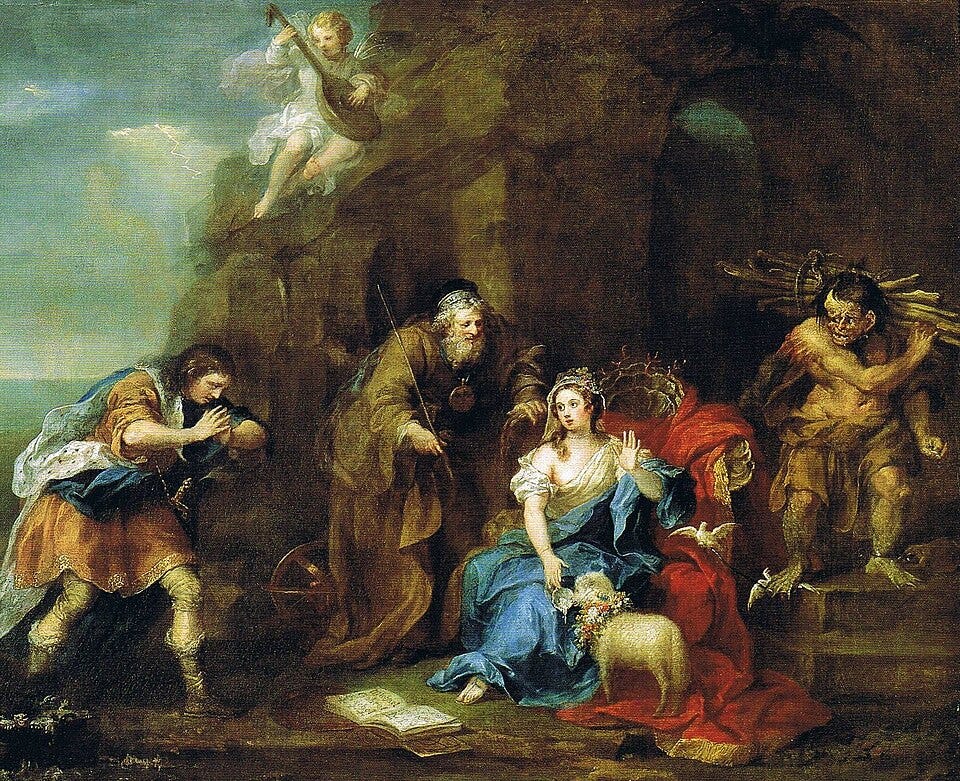

I just went to see Kenneth Branagh in The Tempest at the RSC. Overall, I found it to be a great production - somewhat old-fashioned, but in its own way refreshing, given the direction in which theatre has been going recently. As for the play, it took me a while to grapple with the text, not least because - when I studied it in the 1990s - we were taught to read it through the lens of postcolonialism. Yes, The Tempest is a play about imperialism - but now I have studied history for a couple of decades, I would say that this is just one - narrow - way of interpreting it. Ultimately, I see The Tempest as a meditation on leadership: how can you be powerful and still retain your humanity? How can people be subject to government but also be free?
Shakespeare wrote the play around 1610/11, under the rule of James I of England and VI of Scotland. When James came to the English throne in 1603, he was initially tolerant of Catholics, but was obliged to penalise them harshly following the Gunpowder Plot of 1605. Prospero is not unlike James, in that he is obliged to use his strength to avoid a state of chaos, but he is also aware that it must be tempered by humanity.
The play reminded me a lot of As You Like It, in its concern for ‘English liberty’. The ideal manner of governance, as Shakespeare saw it, was Protestant - as opposed to the Catholicism of Spain or France. In England, this meant that the monarch ruled by the will of the people, whereas Spain and France had ‘absolute’ rule - i.e., the monarch was elected by God and therefore you did what you were told. Without question.
Let’s look at the opening of The Tempest, where a ship containing the Italian monarch, Alonso, is apparently about to be wrecked. Check out how the Boatswain speaks to the King and Antonio, the Duke of Milan:
King Alonso: Good boatswain, have care. Where’s the master? Play the men.
Boats. I pray now, keep below.
Duke Antonio: Where is the master, boatswain?
Boats. Do you not hear him? You mar our labour: keep your cabins: you do assist the storm.
Then Gonzalo (the patient counselor) weighs in and says to the Boatswain: ‘remember whom thou hast aboard’. The Boatswain’s reply?
None that I more love than myself.
Here, the Boatswain gives a robust English reply. He is not going to waste time grovelling to these people in an emergency. The King’s job is to get into the cabin and stop interfering, and the Boatswain’s job is to prevent them all from drowning. But the point of this scene is that we are meant to notice the absolutist manner of the King and Antonio - and start to be worried about the state of Milan.
Another function of this opening scene is to introduce the two main themes of the play, namely, power and freedom. We then switch to Prospero, whom we learn has created the storm through magic. He explains to his daughter, Miranda, some of the events that led to their exile. Because Prospero was ‘transported / And rapt in secret studies’, he asked his brother to temporarily look after Milan, but Antonio saw an opportunity and seized power: an act which the King tacitly approved. So our fears are realised: this is an absolutist government, run by tyrants.
Subsequently, Prospero and the infant Miranda escaped to the island, and were aided by Gonzalo, who furnished them with clothes and important books from Prospero’s library. Prospero says several times that he prizes his books ‘above my dukedom’, and his creation of the storm suggests that his absorbing studies in Milan were actually of an occult nature. Don’t forget that in Shakespeare’s period, the use of magic was a real concern (see King James’s dissertation Daemonologie, published in 1597). Caliban later confirms the importance of Prospero’s (spell) books: ‘First possess his books; for without them / He’s but a sot, as I am’.1
Prospero seems ambiguous at first, and for a while we don’t know if he is also an absolutist ruler. By neglecting his dukedom to study magic, he has been concerned with increasing his power. On the island, he immediately takes control, effectively usurping the only inhabitant: Caliban (a ‘monster’ who smells like a fish). He also saves a spirit called Ariel, who then becomes bound to him as a slave. Both of these characters are obsessed with freedom, and Prospero appears to toy with them, just as he toys with Alonso’s son, Ferdiand, who gets washed up on the island and falls in love with Miranda.
Is Prospero a hero or a villain? Taking the play from the postcolonialist standpoint, he is clearly a villain. However, I was impressed with Richard Eyre’s direction at the RSC because - with a genial Branagh in the lead - he avoided this narrow interpretation. Yet the postcolonialist themes were still there in the form of Ashley Zhangazha’s performance - he downplayed the ‘monstrous’ elements of Caliban, arousing our suspicions about Propero’s governanace.2 At the end of the RSC production, Prospero does the right thing - he gives Caliban and Ariel (Amara Okereke) - their freedom. Yet their performances underlined that freedom comes with a price - it requires courage, self-reliance and a willingness to take responsibility.
This interpretation made the final message of the play - that real strength comes through forgiveness - even more moving. The subtley of Branagh’s performance was really enjoyable to watch because we knew, as a leader, he had suffered a transformation of his own. He would now destroy his occult tools and go back to being a fallible human being - not easy, but the noble path. And as the play comes to an end, we too suffer ‘a sea-change / Into something rich and strange’ - though the power of Shakespeare’s art.
A ‘sot’ was a drunkard.
By which I mean, we have a problem with it. Shakespeare and his audiences did not.
Great books refuse to reduce life to comfort. They remind readers that honor, sacrifice, duty, and loyalty may demand a price.