


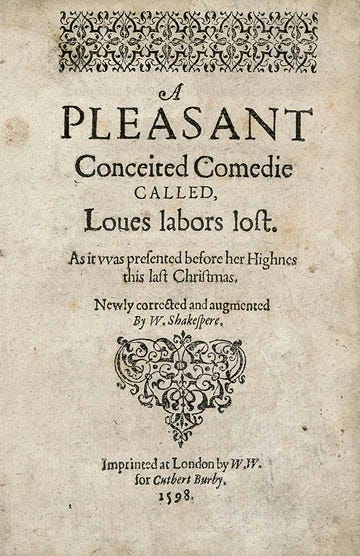

To be honest, reading Love’s Labour’s Lost has been a bit of a struggle. Apart from the usual difficulties of juggling reading with my day job, research, writing etc. I was underwhelemed by my Arden 2nd edition (edited by R. W. David and published in 1951), whose footnotes were almost completely useless. With other plays, this might not be so much of a problem, but Love’s Labour’s Lost is really a play about language, and, as such, it’s larded with sonnets, obscure references and rude jokes. While the 2nd edition repeatedly told me stuff I didn’t need to know (i.e., a ‘gamester’ is a player or gambler) it failed to eliucidate any of the bawdy jokes or illuminate the trickier passages.
Luckliy, the plot is not difficult to follow. The King of Navarre has persuaded three of his lords (Berowne, Dumaine and Longaville) to swear to renounce women while they study for three years. Exactly on cue, the Princess of France visits the court on a mission to recover money owed to her father. She brings with her a lord, Boyet, and three ladies: Rosaline, Maria and Katherine. Immediately, the King breaks his oath by falling in love with the Princess and his lords all follow suit with the ladies. Once the men discover they are all in the same boat, Berowne finds a way to justify their actions. Various japes ensure - including a subplot involving Costard the clown, the boastful Spanish knight Don Adriano de Armado, and his cheeky page, Moth.
At the play’s close, Shakespeare introduces a new character - Marcade - who brings news of the Princess’s father’s death. With the mood unexpectedly plummeting, the Princess and her ladies request that the men wait a year, after which time they will return and marry them. The plot thus goes full-circle, leaving Navarre and his lords pretty much where they started.
At the time of writing, I’m giving the Arden 3rd series of Love’s Labour’s (edited by H. R. Woudhuysen) a whirl, and the scholarly apparatus seem to be a lot better. Nevertheless, I still find this to be a difficult play; as Woudhuysen admits in his introduction:
The shifting sands of Elizabethan court intrigue and literary rivalry provide an attractive foundation on which to build theories about the play and about Shakespeare’s early career, but they distract attention from the play’s far more bracing engagement with its own art and ideas.1
In fact, Woudhuysen - an expert on Philip Sidney - even falls into this trap himself by trying to persuade us that Love’s Labour’s Lost is a comment on Sidney’s Astrophil and Stella. I’m not convinced, but I’m still unsure what Shakespeare was trying to do with this play. As many have observed, there seems to be a strange synergy between Berowne and his ‘dark lady’, Rosaline, and some of the sonnets. But perhaps the thing I found most memorable was Berowne’s obsesson with Rosaline’s dark eyes. We often find certain motifs in Shakespeare’s plays which stand in for a central argument; here I suspect he is thinking of the commonplaces ‘love is blind’ and of ‘blind cupid’.2
But Berowne’s love for Rosaline is anything but blind - he has the arrogant attitude of one who believes he is too good for his beloved (Berowne calls her a “whitely wanton with a velvet brow, / With two pitch-balls stuck in her face for eyes”). However, their sparring is the most entertaining dialogue in the play, and probably foreshadowed the creation of Beatrice and Benedick in Much Ado About Nothing.3 Again, what repeatedly came to my mind was Sonnet 130 (“My mistress’ eyes are nothing like the sun …”) which satirises the poetic catalogue (or ‘blazon’) of a loved one’s merits. Blazons were very popular with Elizabethan writers, but in his sonnet, Shakespeare flips the idea on its head to create an anti-blazon:
I have seen roses damasked, red and white,
But no such roses see I in her cheeks;
And in some perfumes is there more delight
Than in the breath that from my mistress reeks.
I have a feeling that a similar kind of perversity is happening in Love’s Labour’s Lost, particularly at the end of the play. When it was written, comedies were expected to end with marriage for at least the main couple (often multiple couples), yet here we have an apparently subdued ending in which nobody gets married. Again, the most interesting exchange happens between Rosaline and Berowne:
ROSALINE: Oft have I heard of you, my Lord Berowne,
Before I saw you, and the world's large tongue
Proclaims you for a man replete with mocks,
Full of comparisons and wounding flouts,
Which you on all estates will execute
That lie within the mercy of your wit.
To weed this wormwood from your fruitful brain,
And therewithal to win me, if you please,
Without the which I am not to be won,
You shall this twelvemonth term from day to day
Visit the speechless sick and still converse
With groaning wretches; and your task shall be,
With all the fierce endeavor of your wit
To enforce the pained impotent to smile.
A jest's prosperity lies in the ear
Of him that hears it, never in the tongue
Of him that makes it: then, if sickly ears,
Deaf'd with the clamours of their own dear groans,
Will hear your idle scorns, continue then,
And I will have you and that fault withal;
But if they will not, throw away that spirit,
And I shall find you empty of that fault,
Right joyful of your reformation.
BEROWNE: To move wild laughter in the throat of death?
It cannot be, it is impossible.
Mirth cannot move a soul in agony.
Needless to say, Berowne is eventually persuaded to spend 12 months in a hospital cracking jokes in order to prove himself to Rosaline.
This - coupled with the death of the Princess’s father - is why commentators almost always see the ending of Love’s Labour’s Lost as semi-tragic. Indeed, as Berowne says, “Our wooing does not end like an old play” - the work is, perhaps, a sort of anti-comedy in the same way that Sonnet 130 is an anti-blazon. However, it’s possible to take this attitude too far. Woudhuysen has assumed a grim prognosis for the men’s relationships (“not all the couples will get together again - perhaps none will”), as did Harold Bloom, who believed that the men were unlikely to complete their year’s service, let alone get married.4 Kenneth Branagh’s film version of the play (2000) situates the action during World War II: a device which suggests the shadow of death hovering on the horizon.
I take a much more positive view of things. I don’t feel that Shakespeare intended Love’s Labour’s Lost to be doom-laden; indeed, Berowne’s task - to “move wild laughter in the throat of death” - was probably seen as hilarous, especially in a society used to the idea of Memento mori. Berowne is a narcissist and - according to the title page of the first quarto - the play is ‘conceited’, or pregnant with its own ideas. Shakespeare points-up the theme, not only in the play’s title, but in Act One, Scene One, when Berowne complains about the king’s proclamation:
O, these are barren tasks, too hard to keep:
Not to see ladies, study, fast, not sleep.
The pun on ‘barren’ (bleak; unable to conceive) is intentional.
Utlimately, the men (with the exception of Don Armardo) fail to get their ladies either into church or bed - they are what Malvolio might call “barren rascals”. However, the existence of a possible sequel (Love’s Labour’s Won), which has never been found, might suggest that they were successful in the end.5
Love Labour’s Lost, edited by H. R. Woudhuysen (London: Bloomsbury, 1998), p. 72.
The character of Moth (the ‘boy’ or ‘child’) might also be associated with cupid.
Berowne and Rosaline also have things in common with Petruchio and Katherina in The Taming of the Shrew.
Love Labour’s Lost, edited by H. R. Woudhuysen, Op. cit., p. 9; Harold Bloom, Shakespeare: The Invention of the Human (London: Fourth Estate, 1998), p. 143.
For the history of Love’s Labour’s Won see Woudhuysen, p. 80.